
Research, Education, Conference
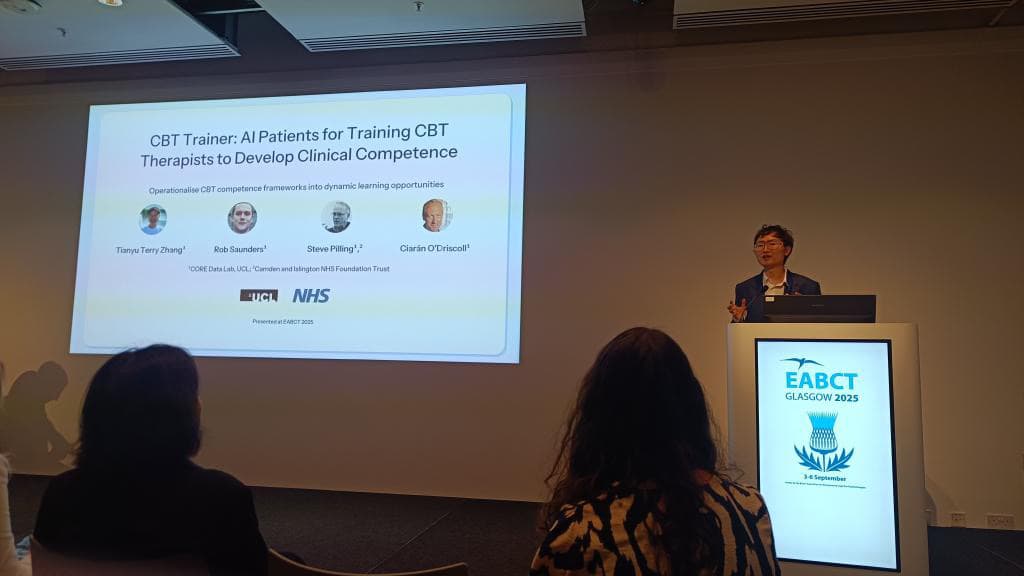
CBT Trainer Presented at EABCT 2025 Congress in Glasgow

CBT Trainer Team
CBT Trainer Presented at EABCT 2025 Congress in Glasgow
We're excited to share that CBT Trainer was presented at the 54th EABCT Annual Congress in Glasgow, Scotland, from September 3-6, 2025. Our research team from UCL's CORE Data Lab had the opportunity to showcase how AI-powered virtual patient simulations can transform CBT training through competence framework-aligned feedback at one of the premier international gatherings for CBT professionals, researchers, and educators.
The European Association for Behavioural and Cognitive Therapies Congress brought together experts from across Europe and beyond to discuss the latest advances in cognitive and behavioural therapies. Our presentation, titled "CBT Trainer: AI Patients for Training CBT Therapists to Develop Clinical Competence," addressed a critical challenge that resonates across training programmes: how to make competence development more efficient, accessible, and engaging for the growing numbers of trainees needed for NHS services.
The Challenge in CBT Training
At the heart of our presentation was a persistent problem in CBT training. While UCL competence frameworks underpin every NHS talking therapies training programme in the country, trainees face significant barriers in their learning journey. They have limited opportunities to practice varied scenarios, and there's considerable difficulty in receiving consistent assessment against framework standards. Our interviews revealed that exposure to situations where trainees can practice critical competencies is highly variable and often dependent on chance, creating inequity in learning opportunities and unnecessary anxiety. Many trainees reported feeling they were "learning on the job" with real patients, creating tensions between their development needs and optimal patient care.
Transforming Competence Frameworks into Practice Tools
CBT Trainer addresses these challenges by reimagining the relationship between competence frameworks and skill development. Rather than treating frameworks as something trainees encounter only at the end of their training during evaluation, we've transformed them into active practice tools throughout the learning journey.
The platform operationalises competence frameworks into discrete, practicable elements, creating realistic scenarios where trainees apply these skills with simulated patients who respond with the complexity of real clinical interactions, all within a psychologically safe environment. What makes this particularly valuable is the breadth of practice opportunities available—trainees can practice with diverse patient presentations including depression, generalised anxiety, social anxiety, PTSD, OCD, panic disorder, and agoraphobia, each with different demographics, backgrounds, and clinical presentations.
Grounded in Learning Science
Our approach bridges established learning science principles, particularly Kolb's Experiential Learning Cycle, which moves from practice through concrete experience, reflective observation, abstract conceptualization, and active experimentation. We also integrate Ericsson's Deliberate Practice principles, incorporating specific goals, immediate feedback, and repetition. The result is faster skill development through immediate, targeted practice that addresses the limitations of traditional role-play methods.
Compelling Pilot Study Results
The pilot study results we presented demonstrated compelling evidence of CBT Trainer's acceptability and utility. Fifty-nine trainees from doctoral and low-intensity CBT programmes engaged voluntarily with the platform, spending an average of over 95 minutes in active role-play practice over just one month. The platform achieved excellent usability ratings with a System Usability Scale score of 82.2 out of 100, well above the threshold for "excellent" usability. Most remarkably, 96% of trainees reported improved assessment skills.
What Trainees Value Most
The qualitative feedback revealed what trainees valued most about the platform. Over 80% appreciated the immediate feedback, with one participant explaining, "Knowing that I could practice anytime of the day made me feel so much more calm about my exam as I didn't have to rely on other people to practice with." Trainees also highlighted how the platform helped build their confidence, with another noting, "Normally I stutter when talking to patients and this helped me to think before I speak." The platform proved particularly valuable for practicing challenging skills, as one participant shared: "CBT Trainer helped me to practice risk assessment and safety planning... work my risk questions in a way that was conversational."
Applications Across Training Stages
These findings point to CBT Trainer's potential to play a valuable role at different stages of training. Training programmes could use the platform for pre-placement preparation to build students' confidence before seeing real patients, or for pre-supervision work so students arrive better prepared. The platform also serves exam preparation needs, enabling practice before OSCEs and helping identify struggling students early. The platform's scalability makes it valuable for supporting large cohorts in training programmes with many students, while its accessible format addresses equity concerns by supporting neurodiverse learners.
Continuous Improvement
Based on the pilot study feedback, we've already made significant improvements to the platform, including Android compatibility, expanded AI patient profiles, and refined feedback formats. We're currently rolling out CBT Trainer across all UCL Clinical Psychology and CBT programmes and actively integrating additional competence frameworks for specialist areas including eating disorders and trauma-focused CBT. Our vision extends beyond general CBT skills to enable trainees to develop competencies in the specific areas they'll be working in.
Serving the Public Good
Throughout the presentation, we emphasised that this work serves the public good. Better therapist training ultimately means better patient care, and that's what drives our development of CBT Trainer. We're actively seeking training programme partnerships and research collaborations because improving the quality and efficiency of how we train therapists benefits not just the trainees and training programmes, but ultimately the patients and clients we've all dedicated our careers to serving.
Get Started with CBT Trainer
For those interested in experiencing CBT Trainer or exploring how it might complement their training programmes, the platform is now available on both iOS and Android. iOS users can download from the App Store, while Android users can now find it on Google Play. Training Programme Directors interested in exploring how CBT Trainer can complement their programmes are encouraged to contact us for more information.
This isn't about replacing human supervision or traditional role-play methods—both remain incredibly valuable—it's about complementing existing training to make it more efficient, engaging, and accessible.
Research Team: Tianyu Terry Zhang, Rob Saunders, Steve Pilling, and Ciarán O'Driscoll
Affiliations: CORE Data Lab, Centre for Outcomes Research and Effectiveness, UCL; Camden and Islington NHS Foundation Trust